


Our Materials
Materials decide how a pair of sunglasses feels, how long it holds up, and what it leaves behind. This page covers what our frames and lenses are actually made of, where those materials come from, and how the claims are verified.
01 / Recycled Plastics
Recycled Plastics
Most of what we make is built from post-consumer plastic: material that has already been through a first life, rather than offcuts swept up on a factory floor. Three grades do the work, each chosen for the part of the frame it sits in.

rPCTG — The Fronts
The front holds the lenses, sets the shape and takes most of the handling. Ours are moulded from rPCTG, a recycled copolyester made from collected post-consumer packaging: bottles, caps and rigid food containers, sorted and washed, shredded into flake, then compounded back into new pellet.
PCTG is hard and dimensionally stable, and it is BPA-free. It holds its shape in heat and in cold, which matters for something that lives in a car in July and a coat pocket in January. The surface takes a deep polish and keeps it.
Our pellet supplier holds a Global Recycled Standard 4.0 scope certificate covering rPCTG at 100% recycled post-consumer content, issued by Control Union.

rCP — The Temples
Every style with an rPCTG front is fitted with temples in recycled cellulose propionate. CP is a cellulose-based plastic, softer to the touch and more forgiving than the front material.
That flexibility is the point. A temple has to give a little to sit on a head, and heads are not standard. With the steel core running through it, the temple can be bent to a width and will hold there.
02 / Recycled Metal
Recycled Copper
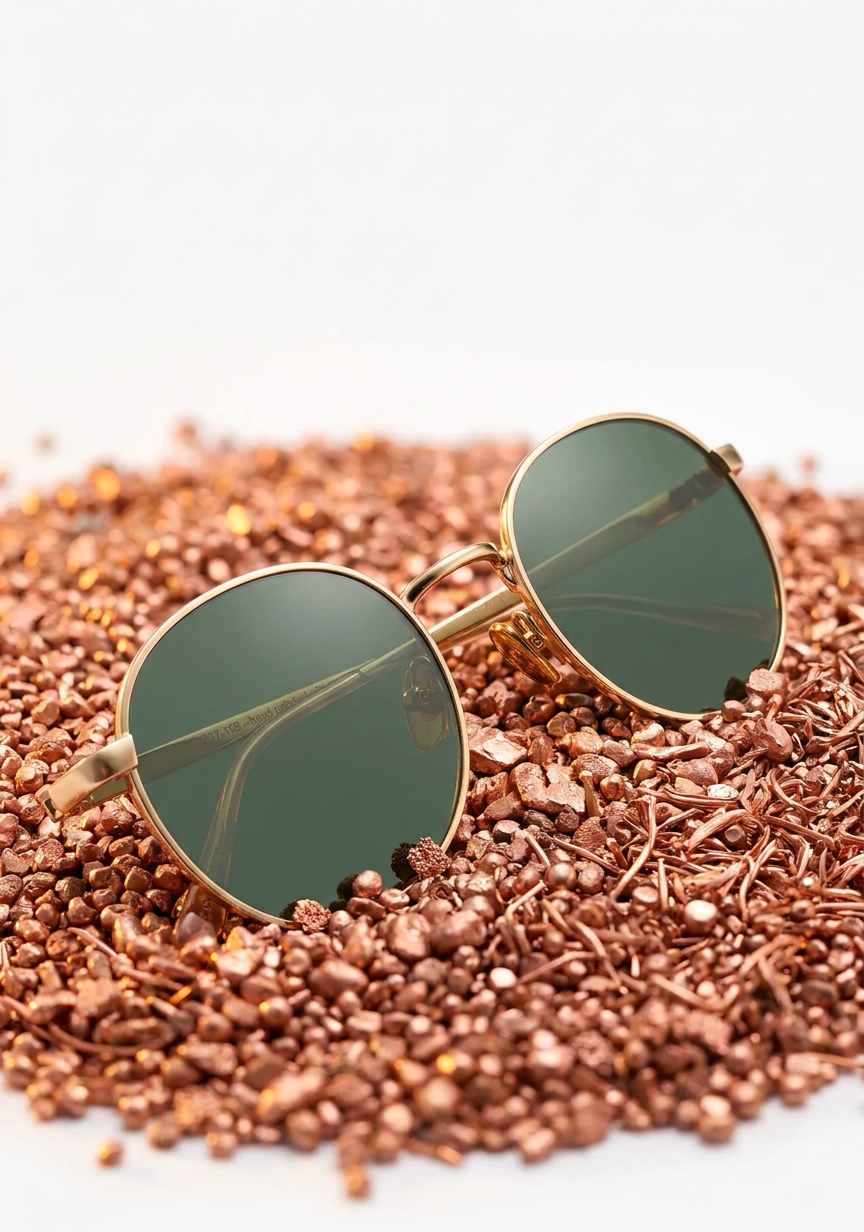
Metal is where recycling works best. Copper can be reprocessed again and again without losing its properties, so recycled copper performs exactly as newly mined copper does. The only difference is where it came from, and the energy it took to get there.
Where We Use It
Any style built on a full metal frame, or with a metal front or metal temples, is made from recycled copper. It is specified at the material level rather than model by model, so it holds as the range grows.
Copper machines cleanly to fine tolerances and takes plating well, which is what makes the finishes possible. It holds a thread, holds tension, and does not become brittle with age.
Our frame factory holds a Global Recycled Standard 4.0 scope certificate from TÜV Rheinland covering eyewear made with recycled post-consumer copper, including lines certified at 100% recycled post-consumer copper for the frame.
03 / Biodegradable Acetate
BioAcetate S70
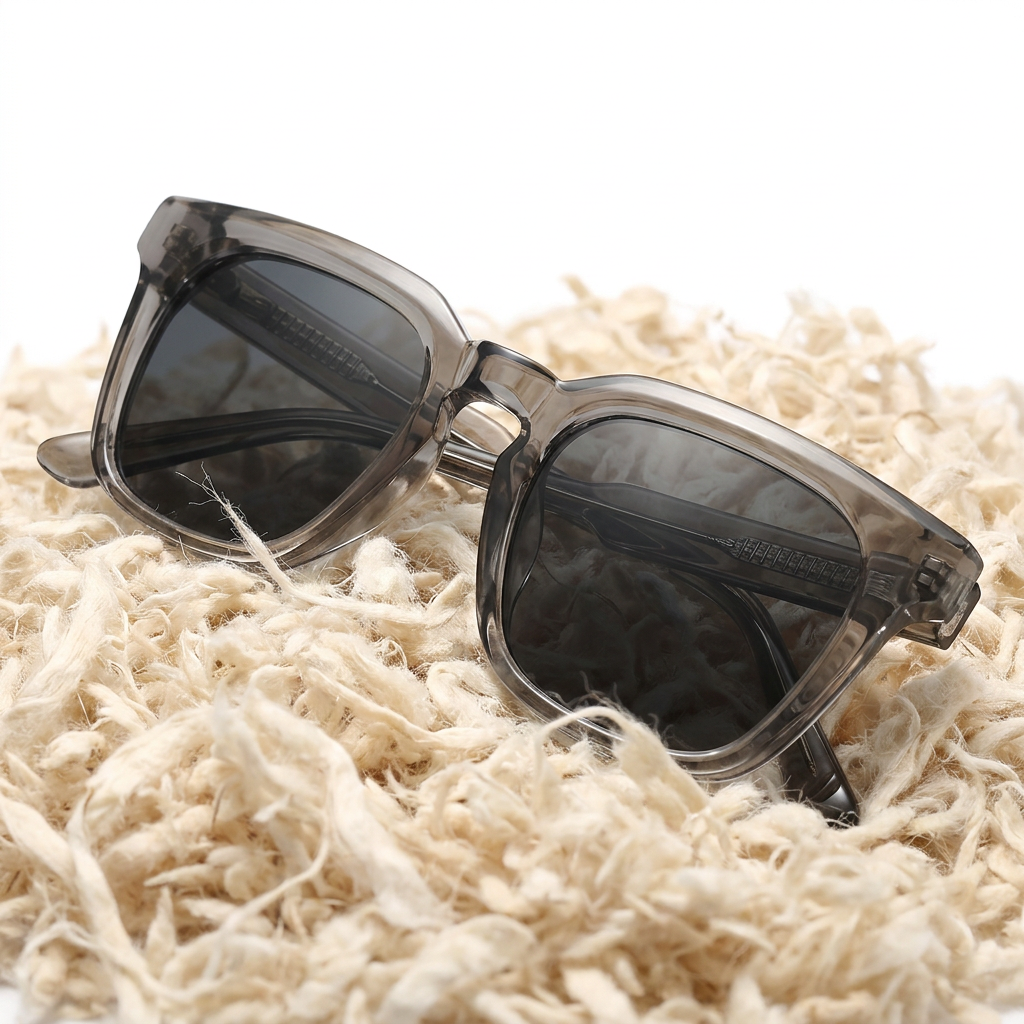
Our Biodegradable Collection is made from BioAcetate S70, a cellulose acetate built on plant matter rather than petroleum, developed by Wingram Industrial Company Limited in Hong Kong. Wingram classes it as a hardness-enhanced acetate: harder than the conventional material, without turning brittle with it. We buy it as granules and mould it, which is a different route to a frame than the sheet acetate most brands describe.
Where It Comes From
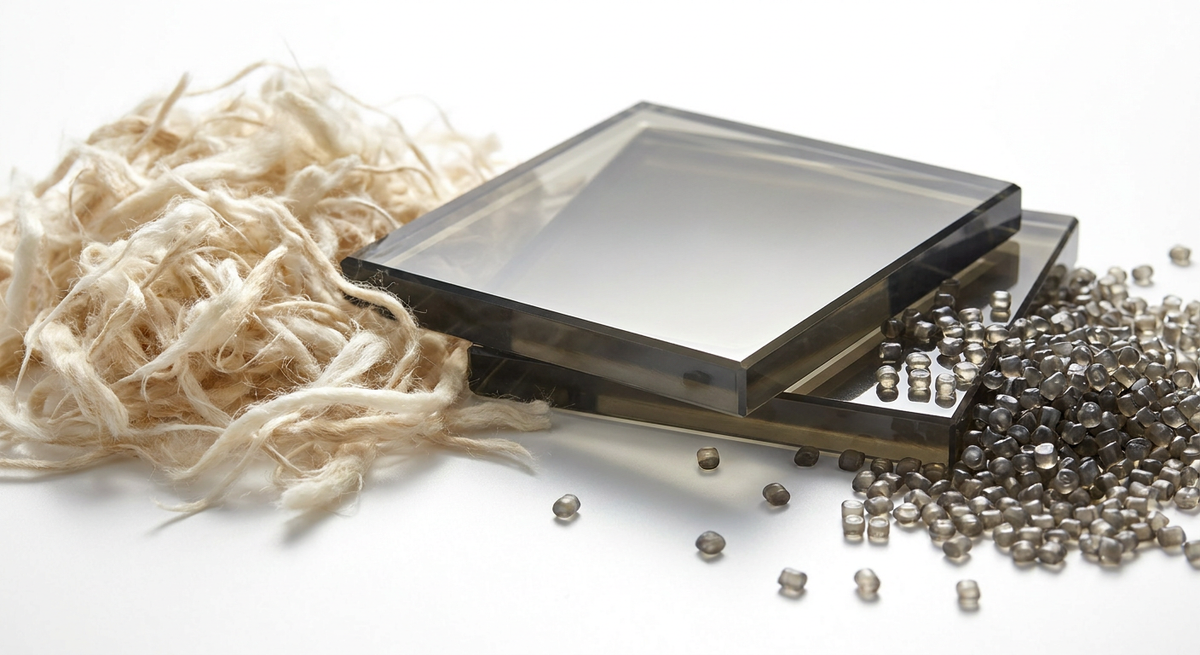
It starts as cellulose from renewable crops, wood pulp and cotton, processed into acetate. The material is pressed into sheets, then granulated into pellets. Those pellets are what arrives at our frame factory, colour already in them.
Independent testing to ASTM D6866 puts the biobased carbon content at 62%. The remaining 38% is fossil-based. A fully plant-based acetate that performs at this level does not exist yet, and development is ongoing.
How We Use It
The pellets are injection moulded. The material is melted and formed in a tool under pressure, rather than milled out of a slab, which is why S70 exists in a grade developed specifically for injection. Not every acetate can survive that process.
The colour is in the granule, not on the frame. It runs through the full thickness of the material, so there is no lacquer to wear thin at the temple tips and no different colour waiting underneath a scratch.
Acetate stays workable once moulded. An optician can warm the frame and adjust it to your face, then adjust it again years later. Combined with the steel core in the temple, that is what makes a fit correctable rather than fixed.
| Tested for | Result | Method |
|---|---|---|
| Biobased content | 62% biobased carbon content, as a fraction of total organic carbon | ASTM D6866-20, Beta Analytic |
| Biodegradation | 92.3% absolute biodegradation after 180 days under controlled composting conditions at 58°C | ISO 14855-1 (2012), OWS, Belgium |
| RoHS | Complies with the limits set by RoHS Directive (EU) 2015/863 | SGS |
| REACH SVHC | Tested substances of very high concern below 0.1% by weight | SGS |
| Bisphenol A | Not detected, below a detection limit of 1.0 mg/kg | SGS, HPLC-MS/MS |
| Skin irritation | Primary Irritation Index of 0.0, categorised as negligible | ISO 10993-10 (2010), GLP study |
Testing was carried out on the raw material by independent laboratories, on behalf of the material supplier. The material is also certified free of DEP, the phthalate plasticiser used in much conventional acetate.
04 / Lenses
Recycled rPMMA
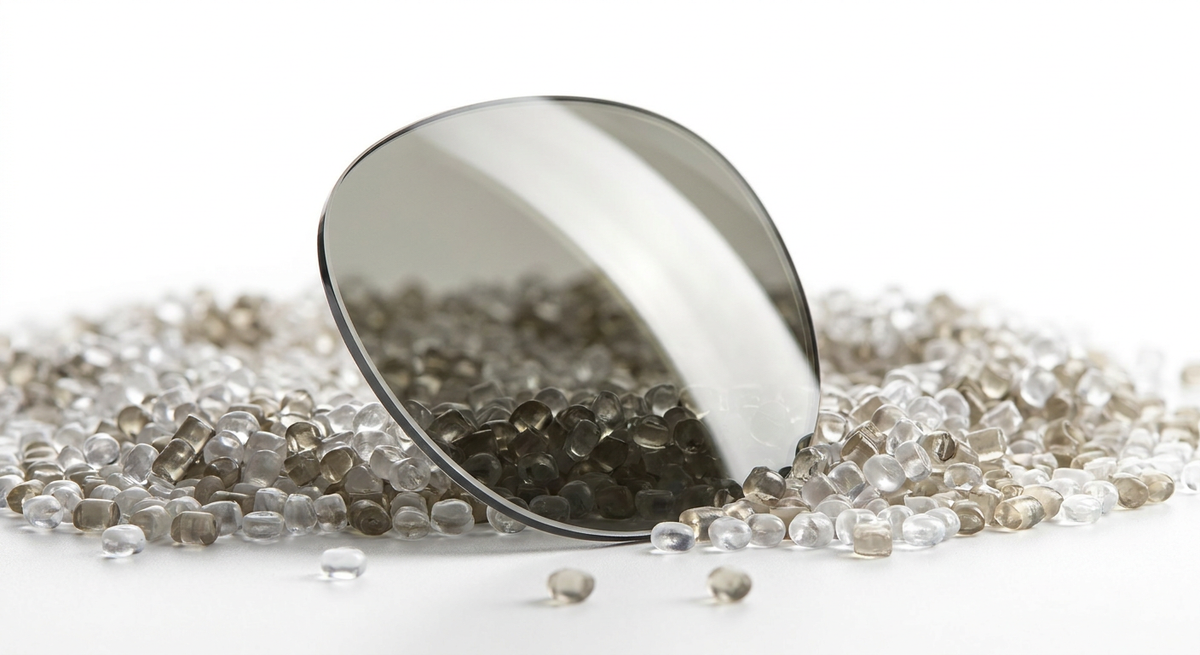
Every lens we fit is recycled PMMA, an optical acrylic. The material is the same across the whole range. What changes from model to model is the tint category and the curve.
Clarity Without the Weight
PMMA gives clear, distortion-free vision at low weight. That is what keeps a frame comfortable across a full day rather than just the first hour.
Recycled does not mean second grade. Our lens supplier holds a Global Recycled Standard 4.0 scope certificate from TÜV Rheinland covering lenses at 100% recycled post-consumer PMMA.
Every lens carries full UV400 protection, blocking all wavelengths up to 400 nanometres, regardless of how light or dark the tint appears. Categories and base curves are covered in detail on our components page.
05 / Verification
How It Is Checked
Recycled content is easy to claim and harder to prove. Ours is certified to the Global Recycled Standard 4.0 at each step of the chain, by independent certification bodies rather than by us.
| Certification | What it covers |
|---|---|
| Global Recycled Standard 4.0, Control Union | Recycled plastic pellets, including rPCTG at 100% recycled post-consumer content |
| Global Recycled Standard 4.0, TÜV Rheinland | Lenses at 100% recycled post-consumer PMMA |
| Global Recycled Standard 4.0, TÜV Rheinland | Frame production, including eyewear made with recycled post-consumer copper |
Our frame factory is also audited under amfori BSCI, the social auditing system used across European retail. The most recent full audit was carried out by SGS.
Better materials are only half of it. How those materials are put together, and whether the result survives daily use, is decided by the components inside the frame.